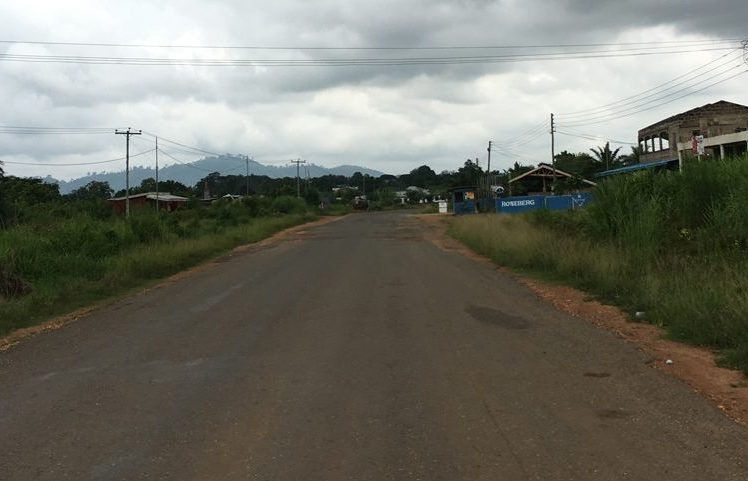
Of all my travels across the globe, it would surprise most people that the two places that have held me in quiet fascination aren’t distant or exotic, but rather towns nestled right next to my ancestral hometown of Hohoe in Ghana: Santrokofi and Lolobi.
These towns border Hohoe to the south and north, and were once part of the Volta Region before being reassigned to the newly created Oti Region. One could walk into either town from Hohoe, and for the more adventurous, a long walk into the heart of each is possible. If marathons were held in this part of the region, they’d almost certainly pass through both towns.
And yet, despite my countless visits to Hohoe since childhood, and despite having lived and worked across oceans, I’ve never truly entered Santrokofi or Lolobi. This proximity without presence has turned into a strange, enduring longing — like a romantic attraction to a mirage. A quiet craving that deepens with time.
The closest I’ve come to seeing Santrokofi—“Sanko,” as it’s affectionately called—was during a brief stop at a roadside house during one of our childhood trips. For Lolobi, it’s been photographs taken by my father or shared through family connections.
I remember that visit vividly. My father, driving his VW Beetle, pulled over to greet someone; perhaps a friend or relative. I don’t recall the purpose of the stop, but I’ll never forget the impression the place left on me. As a child raised in Accra — Ghana’s bustling capital, even Hohoe, with its modest size and development, already felt rural to me. Rural in a beautiful and grounding way.
But Santrokofi was different. It was smaller, quieter, and more intimate in a way that left an imprint. Even from that brief roadside stop, I could see so much: the green-hued mountains standing at a distance, gently enclosing the town like natural stadium walls, with the community nestled at the center like a quiet playing field. Clusters of thatch-roofed and clay-walled homes sat close together, children played freely in open spaces, and the community’s borehole water supply stood in plain sight, with people gathered casually around it. I’ve since heard that these towns also have deposits of iron ore and a tradition of skillfully producing everyday tools. Through local blacksmithing, they produced essential equipment like cutlasses and hoes for farming, and household items including utensils and knives. Their craftsmanship is practical, ancestral, and rooted in the rhythm of rural life.
There was something so human and unguarded about the town — like a place that revealed its heart without hesitation. Now that I look back, the best way to describe how I felt is to compare it to those magical towns in children’s storybooks— places where a child makes a wish and suddenly lands in a softly enchanted world. I thought I’d return soon. But decades have passed, and I still haven’t.
Both Santrokofi and Lolobi are known for their rice farming traditions. Their people, primarily of Guan heritage, are affectionately nicknamed for their relationship with rice, not just for eating it, but growing, harvesting, and selling it as part of everyday life. Historically, they cultivated a unique variety of red-skinned African grains and sticky white rice that held deep cultural significance. These weren’t just crops, but ancestral gifts handed down through generations. While urbanization has brought change and diversified the types of rice now grown, that legacy still lingers.
What amazes me today is how strongly the traditional rice farming culture in these Ghanaian towns mirrors that of rural Asian communities I’ve come to admire through digital media. Thanks to cable TV and social platforms, I’ve found myself pausing mid-scroll to immerse in images and videos of Asian rice villages — terraced farms, barefoot farmers, simple kitchens, and elders sorting herbs. These scenes send a jolt through me. They remind me of Santrokofi. The rice. The children darting past goats. The cooking over open fires. The homes shaped from natural materials. It stuns me how strongly connected I feel to places I’ve never visited, and how untouched I remain by the ones right next door.
It’s not always luxury resorts, glassy high-rises, or Michelin-starred restaurants that leave the deepest imprint on a traveler. Sometimes, it’s a clay house on a quiet hill or in a valley. A woman pounding rice outdoors. A child chasing a rolling tire. A rhythm of life so simple, so authentic, it stays in your soul far longer than anything neon-lit.
There’s something profoundly moving about places that don’t even see themselves as destinations. Villages like Santrokofi and Lolobi may view their humble, resilient lifestyles as ordinary. But to someone like me, they represent the very essence of meaningful travel.
If only more tourism companies recognized this. If only travel content creators and boards helped small towns see their worth. These places are rooted in heritage, rich in community, and full of wonder. The smell of rain on red earth. Livestock meandering through homes. Homes crafted from what the land provides. These are not just sights; they are stories.
Someday, I’ll go beyond Hohoe, through its borders into Santrokofi and Lolobi. I’ll walk. I’ll talk. I’ll eat their rice. I’ll sit beneath their trees and listen. And maybe, in doing so, I’ll finally close the loop on a longing that was never really about distance, but about truly seeing what’s always been right beside me.
There’s a bigger picture here, and it’s one we must all learn to see. For tourists seeking meaning over luxury, for travel companies shaping future itineraries, for local and national authorities tasked with promoting culture and economic growth, and for the townsfolk themselves — there is value in the heritage that lives quietly in places like Santrokofi and Lolobi. These are not just communities; they are living legacies. In a borderless, digitally connected world, there’s never been a better time to recognize what makes such towns extraordinary. As long as we do so in ways that honor and preserve their environment. Let us tell their stories. Let us present them with pride. And let us position them, not as forgotten corners, but as destinations rich with culture, history, and humanity that the world is waiting to discover.

