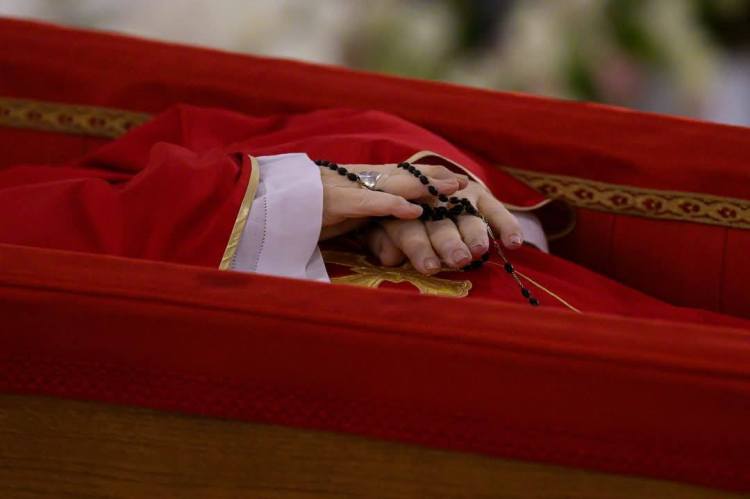
One of the most sobering moments in contemporary Catholic history, for me, was the passing of Pope Francis. When the Pope was hospitalized in February, concern quickly spread across the globe. Even his doctors later admitted they feared the worst. And yet, in true Francis fashion, he recovered. He was discharged, declared out of immediate danger, and entered a recovery phase. Then came Easter.
To the astonishment and joy of many, Pope Francis appeared in St. Peter’s Square on Easter Sunday. It wasn’t just a brief moment. In what now feels like a parting gift to the Church, he blessed the crowd and then toured St. Peter’s Square in the Popemobile — offering comfort and joy to the faithful. That singular moment spoke volumes: about resilience, grace, and a shepherd’s steady love for his flock.
To say that moment meant something to me, as someone born into the Catholic faith, is an understatement.
My earliest memory of Catholicism began as a toddler during a vacation with my grandparents in Hohoe, Ghana. My family had been Catholic for generations. One of my great-grandfathers, Francis, played a pivotal role in holding the local church together when missionaries transitioned leadership to the community. From both sides of my family, the Church ran deep—its teachings, its rituals, and its spirit shaping our lives. I still remember my grandfather Herman falling to his knees in prayer at the sound of the church bell, or how he’d insist that any grandson who skipped Sunday Mass would go without meat at dinner.
During one of those childhood visits, Grandpa enrolled me temporarily in a Catholic day nursery behind his house — St. Augustine’s. It was there I experienced, perhaps for the first time, the Church’s legacy of charity in the most tangible way.
One day, we were told to bring scarves to school and to make sure our parents or guardians came for us at day’s end. We didn’t ask questions; we just obeyed. That afternoon, we left school carrying food—wheat grains bundled in scarves—while the adults who came for us carried the bulk of the items: packets of powdered milk, cereals, and gallons of cooking oil. The food was for us, but the joy of it was shared. I still remember my grandmother clapping and teasing my cousin and me that evening at dinner time, pretending we had brought food home to feed the entire household. It was a small moment, but it stayed with me; a simple gesture that embodied generosity, dignity, and care.
Over the years, we returned often to Hohoe — not just for holidays and family gatherings, but also for funerals, which became solemn occasions that brought extended family together and reaffirmed our faith. These ceremonies were always held in the same church where many of us had been baptized. The old cemetery, a short walk from both the church and our homes, held generations of loved ones. My father, a mechanical engineer, built the cart that carried the coffins to the cemetery for the church. All of my great-grandparents are buried there, but two in particular have always stood out in my memory. One has a tombstone adorned with angel wings; the other, sculpted in traditional attire, sits like a sage. That place, that town, was and still is, the spiritual anchor of my family. In Ghana, your hometown isn’t where you were born; it’s where your lineage resides. For me, that place is Hohoe.
On Easter Sunday, April 20, 2025, I couldn’t shake the image of Grandpa from my mind. I had no doubt that, had he been alive, he would have been praying fervently for the Pope. That day, I drove across Burlington County, New Jersey, passing Catholic churches brimming with people. The mood was unmistakable — reverent, hopeful, grateful. It felt as if the entire Catholic world was breathing a collective prayer of thanks for the Pope’s life. As if he had stayed just long enough to see us through Easter.
So it was especially jarring to wake the next morning and learn that he had passed.
In a moment of quiet reflection, I wrote:
“It looked like no Catholic in my neighborhood missed Easter church yesterday. The lots were packed to capacity; latecomers had to return home. Papa Francisco was on our minds, in our hearts, and in our prayers. He couldn’t have chosen a better day to sleep. His work is done. He stayed for Easter, and now he’s resting. God grant him eternal repose.”
There was always something extraordinary about Pope Francis — from the moment he first stepped onto the balcony in 2013. His warmth. His smile. His humility. But most of all, his compassion. His understanding of everyday struggles, his unwavering defense of the poor, his connection to the human condition. These are the qualities that will define his papacy for generations.
He was, and remains, Papa to many of us. And though he now rests, his presence endures.
 Antoinette H. C.